

For much of the past decade, quantum has been sold as a research race.
The scoreboard was familiar: qubit counts, coherence times, error rates, funding rounds, landmark papers and increasingly cinematic promises about machines that would one day change chemistry, logistics, finance and national security. Nothing wrong with that narrative, really, and research still remains indispensable. But it’s no longer sufficient.
The more revealing question in 2026 is not whether quantum technology works in a laboratory. It is whether an organisation can procure it.
Can a defence customer test it against a mission requirement?
Can a critical-infrastructure operator integrate it without rebuilding every system around it?
Can a government assess its supply chain, security exposure, export-control status and sovereign dependency?
Can a vendor manufacture, calibrate, maintain and train people to operate it?
That is the transition now under way. Quantum is becoming less of a science-policy category and more of a procurement category.
And procurement is brutal in a way research is not. Research can reward promise. Procurement rewards delivery.
The buyers have arrived.
The clearest recent example is Canada’s new Quantum Defence Innovation Secure Hub, or DISH.
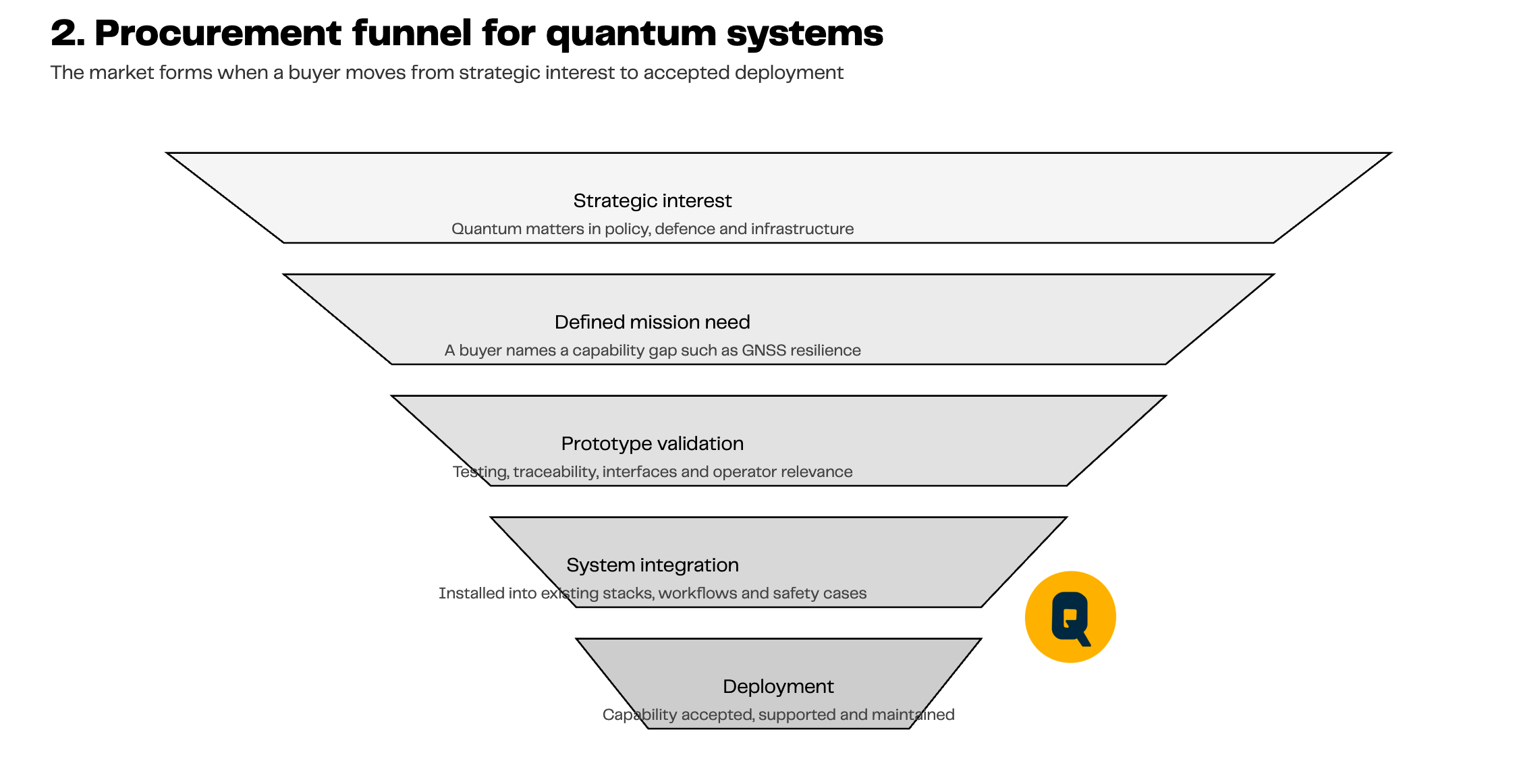
Announced in August, the University of Calgary-led consortium will receive more than CAD $20.3 million over two years to transition domestic quantum work into operational capabilities for the Canadian Armed Forces and Canada’s Communications Security Establishment. The stated target is validated prototypes within two years.
That language should get the industry’s attention.
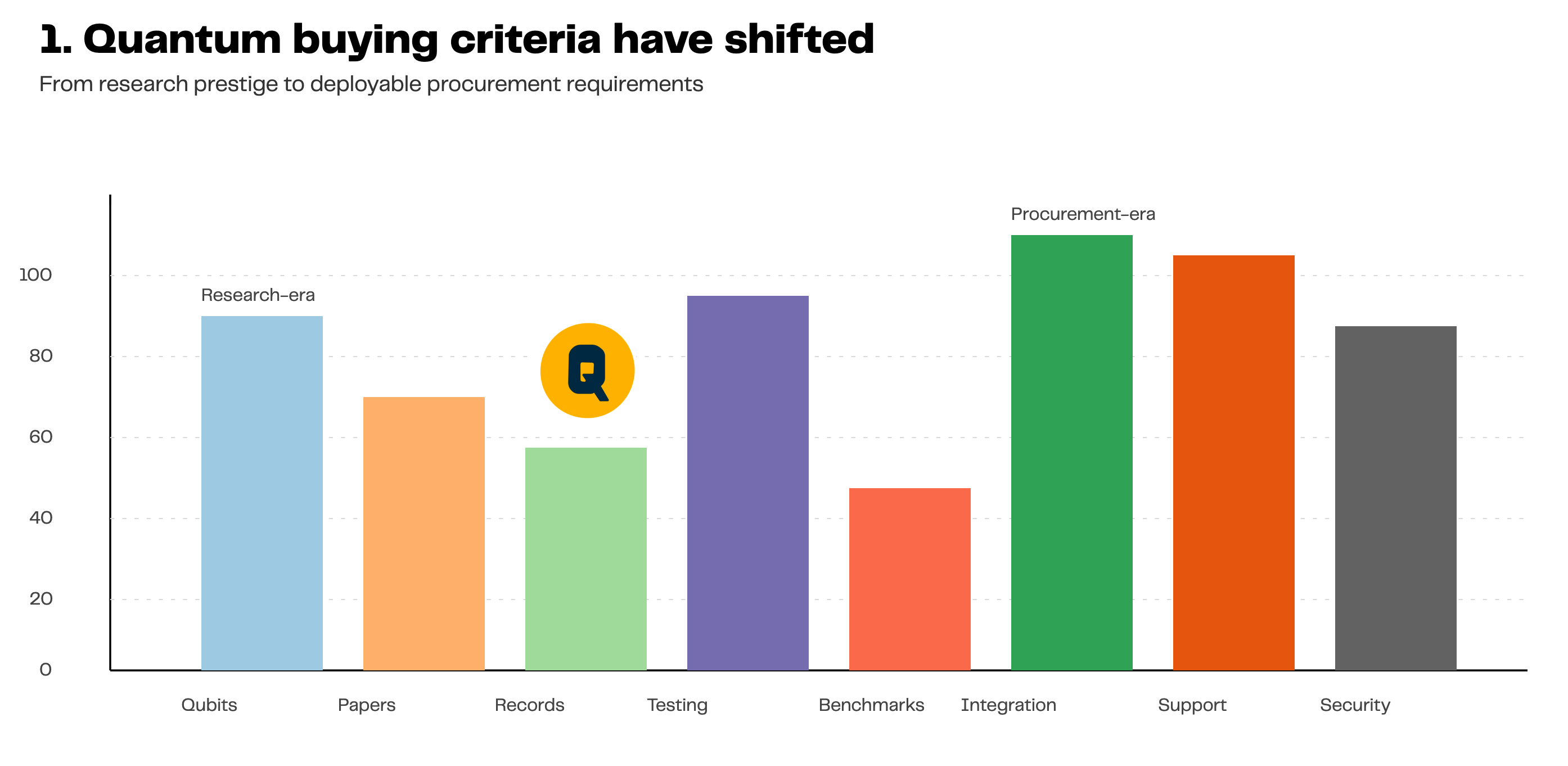
“Validated prototypes” is not an invitation to produce a compelling slide deck, publish a preprint, or demonstrate exquisite sensitivity under carefully managed laboratory conditions. It implies requirements, testing, traceability, interfaces, maintainability and a user who will reject the result if it does not perform.
Canada has also made its priorities unusually explicit.
DISH has four focus areas: quantum sensing, quantum communications, quantum algorithms and quantum hardware assurance. Its sensing and PNT activity includes satellite-independent positioning, navigation and timing, plus tools to detect and counter GPS spoofing in GNSS-denied environments.
This is how a market starts to become real - a buyer identifies a pain point, names a desired capability and funds a route to tested deployment.
It also tells founders where not to hide. A company can no longer simply say that quantum sensing is strategically important. It needs to say:
important to whom, for which operating condition, measured against what threshold, and integrated into whose platform?
Navigation makes it tangible
GNSS resilience is particularly revealing because it converts quantum technology from an abstract promise into a procurement-shaped problem.
Military and civil platforms depend on satellite navigation, but GPS and other GNSS signals are vulnerable to jamming, spoofing and loss of availability. Canada’s DISH programme identifies those vulnerabilities directly and connects them to satellite-independent navigation hardware and countermeasures.
That is why diamond-magnetometer navigation deserves attention. The proposition is no longer merely that an NV centre in diamond can measure magnetic fields with extraordinary sensitivity.
The commercial question is whether a magnetometer, coupled with inertial data, geomagnetic maps and intelligent fusion software, can provide a useful resilience layer on an aircraft, autonomous system, ship or ground vehicle when GNSS cannot be trusted.
The wording matters. In the near term, this is unlikely to be a neat “GPS replacement” story. It is a navigation-assurance story: detect deception, estimate confidence, preserve a bounded position solution and decide when a platform should degrade, divert, continue, or hand control to another modality.
That is a much more credible product category. It meets buyers where they are: inside existing navigation stacks, safety cases, operational procedures and upgrade cycles.
For quantum-sensing companies, the prize is therefore not necessarily ownership of the whole platform. It may be becoming the trusted sensing, fusion, integrity-monitoring or decision-support layer inside a larger system procured by aerospace, defence, maritime or industrial customers.
Manufacturing is the test
The procurement shift is also exposing a harder truth.
quantum hardware is not mainly constrained by ideas. It is constrained by repeatable engineering.
Princeton University will lead MARQUIS, a new National Science Foundation Quantum Leap Challenge Institute funded with $27.9 million over five years. Its remit is unusually concrete, for example materials and fabrication methods for superconducting quantum processors, with a particular focus on reinventing the Josephson junction. The institute brings together nine institutions and will also develop validation methods for mid-scale processors and workforce programmes.
This is not a story about a new record-setting processor. It is a story about the thing the field needs before record-setting processors can become reliable products.
The Josephson junction is a foundational component of superconducting qubits.
If its fabrication is variable, then device performance becomes variable.
if device performance is variable, yields suffer.
if yields suffer, delivery schedules and costs become unpredictable.
A buyer does not procure “potential.” They procure a specification that can be met more than once.
The same industrialization signal is visible in the UK. Infleqtion’s new Quantum Innovation Centre at Oxford Technology Park is intended to triple the company’s UK research, production and systems-integration capacity, explicitly combining quantum research with manufacturing and integration. That deserves more attention than another qubit-count announcement. A quantum company’s ability to manufacture, assemble, calibrate, test, qualify and service systems may soon matter more than the marginal performance advantage of its latest laboratory device.
This is the semiconductor lesson arriving in quantum:
the breakthrough is not merely making one exceptional device. It is making a supply chain that can make many sufficiently good devices, predictably.
Sovereign buyers change the game
The procurement story is inseparable from geopolitics.
Sweden’s new national quantum strategy links quantum development to research security, foreign-investment screening and export-control monitoring. It also directs public institutions and critical-infrastructure operators towards post-quantum cryptography migration, aligned with EU transition planning over 2026–2030.
This is a major conceptual shift.
Quantum is no longer treated as a standalone R&D portfolio. It is being absorbed into national security policy, industrial strategy, cybersecurity planning and economic sovereignty.
That changes the market in at least four ways:
The buyer may be government, directly through defence, security, infrastructure and research procurement.
The product may need to be sovereign, with controls on foreign ownership, component origin, data access and maintenance.
The vendor may be judged politically as well as technically, including export eligibility and supply-chain resilience.
The customer may buy capability before commercial economics are fully mature, because strategic optionality itself has value.
Pasqal’s August visit from senior Saudi officials illustrates this point. Saudi Arabia’s Minister of Communications and Information Technology, officials from the Communications, Space and Technology Commission, and HUMAIN’s executive responsible for AI infrastructure and cloud toured Pasqal’s French headquarters and production site. They saw a quantum processing unit, a live atom-rearrangement demonstration, and the manufacturing line where systems are assembled, calibrated and tested before shipment.
That is not the choreography of academic collaboration. It is supplier due diligence. A sovereign buyer wants to know more than whether a machine works. It wants to know whether the supplier can ship, support, scale and remain strategically acceptable. The production line becomes as important as the quantum processor.
The stack, not the spectacle
Japan’s Shunkai system offers another version of the same shift.
The country’s first operational full-stack neutral-atom quantum computer was developed through a collaboration between the Institute for Molecular Science, Hitachi and Infleqtion. The system begins at roughly 50 qubits, aims to scale towards about 500, and sits within Japan’s Moonshot programme; Infleqtion was the programme’s only foreign quantum partner.
Fifty qubits does not make Shunkai a production computer in the conventional commercial sense. But that misses the more important point. The project assembles a stack:
hardware, control and software, system integration, institutional capability and a national roadmap.
That is how states and major enterprises will increasingly approach quantum. They will not simply buy a QPU, a sensor or a cryptographic library. They will procure an ecosystem: equipment, applications, training, integration, assurance and long-term supplier relationships.
Quantum vendors that sell isolated components without an adoption path may struggle. Vendors that can help a buyer operationalize a capability will be much better placed.
The uncomfortable implication
The quantum sector still speaks too often in the grammar of research: breakthrough, novelty, scaling law, benchmark, scientific leadership.
BUT buyers speak a different language: requirement, certification, interface, reliability, service-level agreement, total cost of ownership, supply security and time to deployment.
Quantum is not leaving research behind. But the commercial frontier is moving somewhere more demanding. It is moving into procurement. but that does not mean every quantum company must become a prime contractor. It means each must understand its place in a procurement architecture.
Are you the component supplier?
The specialist subsystem?
The integration layer?
The validation provider?
The cybersecurity migration partner?
The systems engineer who turns a delicate sensor into a deployable capability?
The winning pitch is no longer: “Our quantum technology is extraordinary.”
It is: “Here is the operational problem; here is the performance threshold. here is how we fit your existing system. here is who supports it. here is how it is secured; and here is the route from pilot to deployment.”
That is a less glamorous story than a breakthrough paper. It is also how industries are built.