


Quantum’s first commercially important breakthrough may be invisible, and it may not even look like one.
There may be no consumer application, no household product, and no single launch moment that makes quantum computing suddenly understandable to everyone. Instead, the technology may first become valuable in places where most people never see it: research laboratories, industrial supply chains, secure communications, aerospace systems, and national infrastructure.
But that is not a weakness in the technology. instead, it’s a clue about how quantum computing will actually enter the economy.
What this article covers
Why quantum’s first breakthrough may be invisible
Why qubit counts are not the measure of value
How quantum becomes useful through hybrid workflows
Why post-quantum security needs action now
What organisations and investors should focus on
1. Quantum is not one Technology.
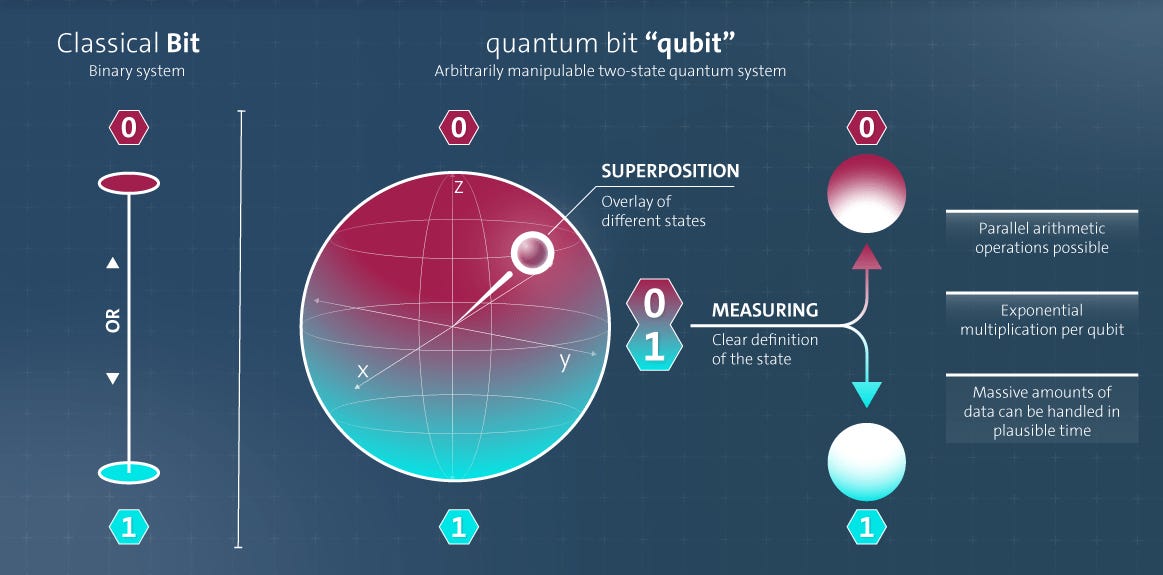
I was reading a LinkedIn article about quantum’s possible “ChatGPT moment,” and the comparison is fascinating. AI became mainstream because it could be placed behind a simple interface. ChatGPT allowed millions of people to experience the value of decades of research without needing to understand neural networks, training data, or GPU clusters.
But quantum is not one technology. It includes computing, sensing, communications, timing, and security and each will reach the market differently. Some quantum capabilities may never have a consumer-facing “moment” at all. A quantum sensor may improve infrastructure monitoring, navigation, medical imaging, or industrial inspection without the end user ever knowing it is there. Quantum-safe security may protect data and communications silently in the background.
The comparison with AI is therefore useful only up to a point. Quantum’s first breakthrough may not be a single interface used by millions. It may be an invisible improvement to a critical system: a more accurate measurement, a more resilient network, a safer asset, or a decision that becomes better, faster, cheaper, or newly possible.
Quantum computing is just one part of that picture. Unlike a conversational AI system, a quantum processor does not answer a vague question in natural language. It requires a carefully formulated problem, an appropriate algorithm, classical pre- and post-processing, and hardware capable of producing a reliable result.
That means quantum adoption will probably begin with well-defined, high-value problems, not general-purpose experimentation.
The first customers may not ask for “quantum computing.” They may ask for:
A better molecular simulation.
A more efficient logistics plan.
A new material with specific properties.
A more accurate model of a complex physical system.
A way to protect long-lived data from future cryptographic attacks.
The quantum hardware may sit several layers below the customer relationship.
2. The real bottleneck is reliability
The industry often talks about qubit counts because they are easy to communicate. But physical qubits are not the same as useful computational capacity.
Qubits are vulnerable to noise. Operations introduce errors. Connectivity, control electronics, calibration, measurement, and environmental stability all affect performance.
The important unit is therefore the logical qubit: an error-corrected qubit constructed from multiple physical qubits.
The challenge is circular:
More physical qubits are needed for error correction.
Error correction requires additional operations.
Those operations can themselves introduce errors.
The system becomes useful only when correction removes errors faster than the computation creates them.
This is why scaling quantum computing is not simply a matter of manufacturing more chips.
The industry must demonstrate a credible path from today’s noisy devices to machines capable of executing long, complex algorithms with sufficiently low error rates. Google’s Willow work on below-threshold error correction is important because it addresses that question directly: does increasing the error-correcting code reduce the logical error rate? The result suggested that it can. That is an engineering milestone, but not yet a commercially useful quantum computer.
3. Advantage is not one thing
The phrase “quantum advantage” is now used too broadly.
A benchmark win may show that a quantum processor can outperform a classical system on a carefully selected task. It does not prove that the result is useful, affordable, scalable, or relevant to an industrial customer.
the right way to bifurcate it is in computation and economically.
Computational advantage
Can the quantum system outperform a classical method on a defined task?Practical advantageDoes the task correspond to a meaningful real-world problem?
Economic advantage
Does the benefit justify the cost and operational complexity?Strategic advantageDoes the capability change the position of an organisation or state?
The industry has produced credible evidence for selected computational advantages. It has not yet established broad economic advantage.
That is the standard investors, governments, and corporate buyers should use.
Not: “How many qubits does the machine have?”
But: “What decision becomes better, faster, cheaper, or possible because this system exists?”
4. Quantum’s value may be embedded
The most important quantum applications may never be sold as quantum applications.
A pharmaceutical company may purchase a drug-discovery platform. An aerospace company may use a materials-design workflow. A manufacturer may optimize a complex scheduling problem. A government may upgrade its cryptographic infrastructure.
The customer will care about the outcome, not whether the calculation was performed on a superconducting processor, an ion trap, a photonic system, or a hybrid classical–quantum architecture.
This has significant consequences for the market.
The companies most likely to capture value may not be the ones with the most impressive hardware demonstrations. They may be the companies that integrate quantum capability into existing workflows:
Data pipelines.
Simulation platforms.
Digital twins.
High-performance computing environments.
AI systems.
Industrial software.
Cybersecurity architectures.
Sector-specific decision tools.
Quantum will need to fit into the customer’s technology stack before it can transform the customer’s business.
5. Hybrid computing is the bridge
The likely path to adoption is hybrid.
Classical computers will continue to handle data preparation, optimisation, orchestration, error mitigation, and result interpretation. GPUs may support simulation and machine-learning workloads. Quantum processors may be used for particular subroutines where they offer a measurable benefit.
This is less dramatic than the idea of a standalone quantum computer replacing classical infrastructure. It is also more plausible.
In practice, the question will be how effectively the full system works:
Business value=quantum contribution−integration cost−operational overhead\text{Business value} = \text{quantum contribution} - \text{integration cost} - \text{operational overhead}Business value=quantum contribution−integration cost−operational overhead
A quantum algorithm that is impressive in isolation may have little value if moving data to the processor, managing the workflow, or interpreting the output costs more than the benefit it creates.
The winning architecture will not necessarily be the machine with the best headline specification. It will be the system that delivers the strongest end-to-end result.
6. Security is already a business problem
Cryptography does not need a fully fault-tolerant quantum computer to become a board-level concern.
Organisations are already being asked to assess which information must remain confidential for decades, where public-key cryptography is embedded, and how long migration will take.
NIST has finalised post-quantum cryptographic standards, including ML-KEM, ML-DSA, and SLH-DSA. The practical challenge now is deployment: inventorying systems, replacing vulnerable algorithms, updating protocols, testing interoperability, and managing legacy technology.
The “harvest now, decrypt later” threat is particularly relevant to information with a long confidentiality lifetime. Sensitive government records, intellectual property, health data, financial information, and strategic communications may still have value when cryptographically relevant quantum machines become available.
Migration should therefore be treated as a resilience programme—not as a prediction that a cryptographically relevant quantum computer will appear on a particular date.
7. What should organisations do now?
The right response is neither blind optimism nor passive waiting.
Organisations should:
Identify problems where an improved solution would have high economic or strategic value.
Establish classical baselines before testing quantum approaches.
Track the complete workflow, including data movement and integration costs.
Experiment with hybrid algorithms rather than treating quantum hardware as a replacement for classical systems.
Build relationships with universities, hardware providers, software companies, and domain experts.
Begin post-quantum cryptography inventories and migration planning.
Evaluate vendors based on evidence, reproducibility, and customer outcomes—not qubit counts alone.
For investors, the same principle applies.
The most durable opportunities may sit in the enabling layers: control systems, error correction, cryogenic electronics, photonics, quantum networking, compilers, orchestration, benchmarking, cybersecurity, and vertical software.
The question is not simply which company will build the largest quantum computer.
It is which companies will remove the barriers between a quantum processor and a paying customer.
8. The breakthrough will be a workflow
Quantum computing does not need to transform every industry to matter.
It may only need to become decisively better for a small number of high-value problems. That could be enough to change research priorities, create new technology platforms, and establish strategic dependence on quantum-enabled infrastructure.
The defining milestone will therefore be more specific than “quantum advantage.”
It will be a complete workflow that survives serious scrutiny:
A real customer problem.
A reproducible quantum contribution.
A strong classical comparison.
A measurable economic or strategic benefit.
A path to deployment at an acceptable cost.
That is the standard the industry should aim for.
Not spectacular benchmarks.
Not speculative timelines.
Not another attempt to manufacture a consumer “moment.”
The first commercially important quantum breakthrough may be almost invisible from the outside. It may appear as a better molecule, a stronger material, a more efficient network, or a more resilient security system.
By the time the public notices the quantum layer, the most valuable companies may already have been built around it.
Sources
Google Quantum AI, “Quantum error correction below the surface code threshold,” Nature, 2024.
Google Quantum AI, “Quantum Echoes: verifiable quantum advantage,” Nature, 2025.
Google Quantum AI, “Quantum supremacy using a programmable superconducting processor,” Nature, 2019.
IBM Quantum, public fault-tolerance roadmap.
National Institute of Standards and Technology, FIPS 203, FIPS 204, and FIPS 205, 2024.
National Institute of Standards and Technology, post-quantum cryptography migration guidance.
Jumper et al., “Highly accurate protein structure prediction with AlphaFold,” Nature, 2021.
Brown et al., “Language Models are Few-Shot Learners,” NeurIPS, 2020.

